- Didactic guidelines -
General guidelines for teachers
This project is made up of four different missions whose main topic is the Body. There are activities to do individually or in pairs.
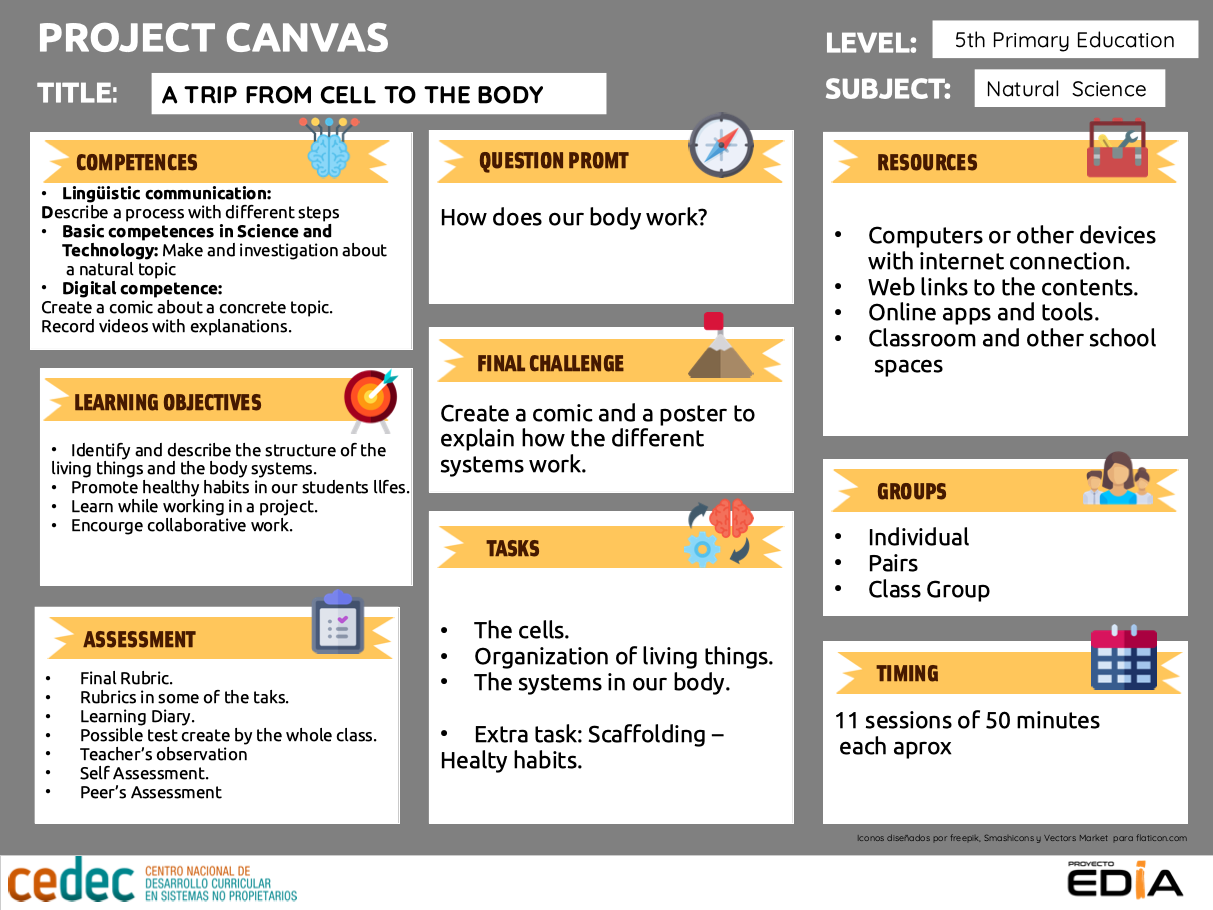
This project is part of a set of some projects designed to cover all the learning standards of the Natural Science curriculum of Primary Education are published at the BOE (March 1st 2014), pages 17 - 21. With this project you will be able to let your students be autonomous learners and guide them through their learning.
There are activities which involve both individual work, collaborative pair work and group work.
We strongly recommend to work with them through daily aims to get to the end of the project and accomplish each challenge successfully. This means at the beginning of each lesson you should take five minutes to check where your students are and to tell them where you would like them to get at the end of the mission.
For example: 'At the end of the mission each student will have had to finish the presentation, which will be checked by the teacher'.
Each project is student-centred and has several areas of interest:
- In each project, students have to accomplish a task, in order to learn something useful for their big final task.
- There is also a challenge in each task, where they have to collaboratively design a product. They are expected to actively work with information and communication technologies. They will be a portfolio to show all their knowlegde along this set of tasks.
- Students also have to complete a learning diary, using a sharing document using the different tips we offer to the students at the end of each mission.
- Student will also have a personal portfolio, where they have to reflect on the different contents they are working on, they have to upload the different audios and videos they produce, and they have to share the link to the different post of their project.
To sum it up, they are going to work on all the contents of the syllabus of their level with a project-based learning orientation.
Assessing
For assessment, both you as a teacher, and your students, are expected to use the the rubric to assess a final task (download in editable odt format, download in pdf).
This project is designed to be assessed following this pattern:
- The Teacher will evaluate the final post on the blog - portfolio with all the products produced during the project following the rubric. It will be 40% of the final score.
- The partners will carry out peer assessment the work and grade about how their teamwork has worked. It will be 20% of the final score . The students can generate the different criteria or items to be assessed.
- Students will self-assess the final task using the rubric. It will be 20% of the final score.
The final score will also include a 20% for the teacher to evaluate how the students have been involved in the project or tackled the different activities.
At the end of the project the student will have been able to:
- Identify different kind of cell
- Describe the cells and their main parts
- Understand how the living things are organized
- Identify the different systems of the body
- Create a comic to explain how each system works
- Reflex about the learning process and the achieved knowlegde along the topic
Curricular references
- Contents
-
Contenidos siguiendo el Curriculo del BOE (March 1st 2014), pages 17 - 21.
Bloque 1. Iniciación a la actividad científica.
- Iniciación a la actividad científica. Aproximación experimental a algunas cuestiones.
- Utilización de diferentes fuentes de información (directas, libros).
- Lectura de textos propios del área.
- Utilización de las tecnologías de la información y comunicación para buscar y seleccionar información, simular procesos y presentar conclusiones.
- Trabajo individual y en grupo.
- Técnicas de estudio y trabajo. Desarrollo de hábitos de trabajo. Esfuerzo y responsabilidad.
- Planificación de proyectos y presentación de informes.
- Realización de proyectos.
Bloque 3: Seres vivos
- Organización interna de los seres vivos. Estructura de los seres vivos: células, tejidos: tipos; órganos; aparatos y sistemas: principales características y funciones.
- Respeto de las normas de uso, de seguridad y de mantenimiento de los instrumentos de observación y de los materiales de trabajo.
- Interés por la observación y el estudio riguroso de todos los seres vivos.
- Hábitos de respeto y cuidado hacia los seres vivos.
- Uso de medios tecnológicos para el estudio de los seres vivos.
- Learning standards
-
Estándares de aprendizaje siguiendo el Curriculo del BOE (March 1st 2014), pages 17 - 21.
Bloque 1. Iniciación a la actividad científica.
1.1. Busca, selecciona y organiza información concreta y relevante, la analiza, obtiene conclusiones, comunica su experiencia, reflexiona acerca del proceso seguido y lo comunica oralmente y por escrito.
1.2. Utiliza medios propios de la observación.
1.3. Consulta y utiliza documentos escritos, imágenes y gráficos.
1.4. Desarrolla estrategias adecuadas para acceder a la información de los textos de carácter científico.
2.1. Manifiesta autonomía en la planificación y ejecución de acciones y tareas y tiene iniciativa en la toma de decisiones.
3.1. Utiliza, de manera adecuada, el vocabulario correspondiente a cada uno de los bloques de contenidos.
3.2. Expone oralmente de forma clara y ordenada contenidos relacionados con el área manifestando la compresión de textos orales y/o escritos.
4.1. Usa de forma autónoma el tratamiento de textos (ajuste de página, inserción de ilustraciones o notas, etc.).
4.2. Hace un uso adecuado de las tecnologías de la información y la comunicación como recurso de ocio.
4.3. Conoce y utiliza las medidas de protección y seguridad personal que debe utilizar en el uso de las tecnologías de la información y la comunicación.
4.4. Presenta los trabajos de manera ordenada, clara y limpia, en soporte papel y digital.
4.5. Utiliza estrategias para realizar trabajos de forma individual y en equipo, mostrando habilidades para la resolución pacífica de conflictos.
4.6. Conoce y respeta las normas de uso y de seguridad de los instrumentos y de los materiales de trabajo.
5.1. Realiza experiencias sencillas y pequeñas investigaciones: planteando problemas, enunciando hipótesis, seleccionando el material necesario, realizando, extrayendo conclusiones, y comunicando los resultados.
5.2. Realiza un proyecto, trabajando de forma individual o en equipo y presenta un informe, utilizando soporte papel y/o digital, recogiendo información de diferentes fuentes (directas, libros, Internet), con diferentes medios y comunicando de forma oral la experiencia realizada, apoyándose en imágenes y textos escritos.Bloque 3. Seres vivos.
1.2. Identifica y describe la estructura de los seres vivos: células, tejidos, órganos, aparatos y sistemas, identificando las principales características y funciones de cada uno de ellos.
4.1. Muestra conductas de respeto y cuidado hacia los seres vivos.
4.3. Manifiesta una cierta precisión y rigor en la observación y en la elaboración de los trabajos.
4.4. Observa y registra algún proceso asociado a la vida de los seres vivos, utilizando los instrumentos y los medios audiovisuales y tecnológicos apropiados, comunicando de manera oral y escrita los resultados.
4.5. Respeta de las normas de uso, de seguridad y de mantenimiento de los instrumentos de observación y de los materiales de trabajo. - Key competences
-
At the end of the project the student will have worked and developed these competences:
- Lingüistic communication:
- Student will be able to describe and present a body system.
- Students will be able to describe the cell.
- Maths competences and basic competences in Science and Technology:
- Students will be able to make and investigation about a body system.
- Digital competence:
- Students will be able to create a final product (comic) using an ICT Tool.
- Students will be able to use different links to investigate in the net.
- Learn to learn competence:
- Students will be able to reflex about their learning process everyday by using a tool such a Learning Diary.
- Social competences:
- Students will be able to work in group and asses their working along the project.
- Students will be able to make group decisions to achieve the final product.
- Entrepreneurship competences:
- Students will be able to work automously by following the steps of the investigation.
- Cultural competences:
- Students will be able to learn about the healthy life styles and value to be healthy.
- Lingüistic communication:
Timing.
This project implies the use of about ten or eleven fifty-minute lessons. The timing is, obviously, approximate. It will depend on the learning pace of the students and on their interests and the activities done in class.
.jpg)
The ten - eleven lessons could be used according to this guide:
- The first lesson is for the Breaking the ice.
- Two of the lessons will be to investigate the cell.
- Two lesson will be use to learn about the organization of living things.
- Another four lessons will be to investigate about the body systems.
- There is an extra lesson about Present simple for scafolding the understanding of the grammar the students will need to descrive a process.
- And the last lesson will be a good opportunity to assess students and do the collaborative assesment. And also it would be great to evaluate the project itself.
Resources
ICT resources/apps/tools
For this project you will need the following links to different sites:
- Cells and the human body.
- Organ System for kids by Periwinkle
- Bitesize: Cells to system by BBC
- Levels of organization: Cell, tissues, organs and organ system by Cognito
- Cell, Tissues, organs and organ system by MooMooMath and Science
- Must and mustn't / School Rules
- Learn English Kids - British Council: Modals "must" and "mustn't"
- Englisch-hilfen: must -mustn't exercises.
- Englisch-hilfen: must - mustn't exercises 2
- KidsHealth: How the body works (movies)
- KidsHealth: How the body works (general website)
Tools
- Flipgrid.
- Popplet
- Bubbl.us
- Procreate for Ipad
- Canva
- Picktochart.
- Pixton.
-
- Storyboardthat
- Power Point
- Genially,
- Google Slides.
- SWAY.
How to
- How to use Flipgrid Screen Recording by Myke Tholfsen
- How to record and submit a video by Flipgrid Help Center
- Educators getting started with Flipgrid by Flipgrid
- ¿Qué es visual thinking? y para qué usarlo en educación by Garbiñe Larralde.
- Videotutorial: Popplet. Herramientas digitales básicas para docentes inexpertos por Ingrid Mosquera
- Videotutorial: Bubbl.us. Herramientas digitales básicas para docentes inexpertos por Ingrid Mosquera.
- Videtotutorial Procreate for Begginer by Bardot Brush
- Tutorial Pixton by Ramón Formoso
- Cómo crear historietas fácilmente by Alonso Ararat.
Licensed under the Creative Commons Attribution Share Alike License 4.0